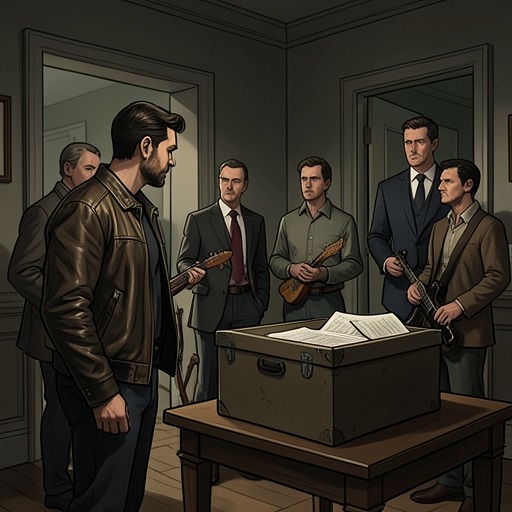
Reverend Gates forced to dance by a white mob
Ma Rainey's Black BottomReverend Gates forced to dance by a white mob is a remembered act of racist coercion that turns a stranded preacher’s attempt to get home into a test of survival. Told by Cutler in the band room, the account links segregation and mob violence to the destruction of religious symbols, then gives Levee Green’s challenge to God a specific human wound: his mother’s prayers went unanswered during an attack.
The Story Cutler Tells
Cutler recounts that Reverend Gates got off a train at Sigsbee to check the schedule and make sure someone would meet him at the right time. Needing a bathroom, he found that the station had no restroom for Black passengers; the only one available was an outhouse about two hundred yards away. While he was inside, the train left without him. Gates had never been to Sigsbee, did not know the town, and was left to work out what to do as evening approached.
As the light faded, Gates noticed a few white men watching from across the street. More joined them. Seeing no Black people nearby, he started walking along the railroad tracks without knowing where he was going. The men called after him using a racial slur; he kept walking until a gunshot fired into the air made him stop. Levee Green interjects that he knows where Sigsbee is and disputes Cutler’s account of Gates getting off a train from Tallahassee. The challenge interrupts the story’s momentum, but Cutler continues with the mob’s confrontation.
Coercion and Survival
The men formed a circle around Gates, who wore a preacher’s cross and carried the Bible he kept with him. When they asked who he was, he identified himself as Reverend Gates and explained that the train had left him behind while he was on his way to visit his sick sister. The mob then demanded that he dance. Faced with the men surrounding him, Gates did so.
One of the white men tore the cross from his neck and accused him of committing heresy by dancing while carrying a cross and Bible. The men tore up the Bible and kept Gates dancing until they were tired of watching. In Cutler’s telling, dancing was the only way Gates got out alive. The episode is thus not a voluntary performance but a demand enforced by a mob that first strips away the symbols of Gates’s ministry and then turns him into an unwilling spectacle.
Cutler says Gates later sat in his own house and told him the story himself. That claim presents the account as testimony received directly from its survivor, rather than as a distant rumor. Toledo says he already knows the facts and has heard the same story many times; he adds that the same thing happened to him. His response places Gates’s ordeal within a recurring pattern of racial violence rather than treating it as an isolated outrage.
From Racial Violence to a Crisis of Faith
Cutler draws a broader conclusion from the story: white people have no respect even for a man of God, and Ma Rainey is only another Black person they can use to make money. The transition connects violence against a preacher to the economic exploitation surrounding the musicians’ recording session. In both cases, Black people are treated as available for white use, regardless of their identity, work, or religious standing.
Levee Green turns the account into a direct challenge to religious faith. If Gates was a man of God, he asks, where was God while the mob terrorized him, and why did God not punish the men? Cutler answers with a warning that Levee will burn in hell, but Levee rejects that as irrelevant to the question. He argues that God is the white man’s God and does not listen to Black people’s prayers. The story’s force in the band room comes from this collision: Cutler offers a survivor’s account as proof of racist cruelty, while Levee treats that cruelty as evidence against the justice of the God Cutler invokes.
The Story’s Immediate Aftermath
Levee Green’s anger becomes personal when he recalls his mother calling out to God for mercy and help during an attack. He asks whether God turned away from her, carrying the remembered plea from the story of Gates into his own family history. The question does not remain an abstract dispute about doctrine: it exposes the grief and distrust beneath Levee’s accusation that God ignores Black suffering.
Cutler can no longer bear Levee’s blasphemy. He jumps up, punches Levee in the mouth, and knocks him down, insisting that the God Levee condemns is his God. Levee then calls on Cutler’s God to save Cutler as he did Levee’s mother. Caught up in addressing God, Levee forgets Cutler and begins stabbing upward into the air. The remembered station encounter therefore sets off a present conflict that moves from testimony, to theological argument, to physical violence; the mob’s forced dance survives in the room as a measure of what the characters believe faith can and cannot answer.